
Ratepayers organisation for the people, by the people to keep politics out of local government
Please Scroll Down for the Afrikaans Version / Rol asseblief na onder vir die Afrikaanse weergawe
INDEPENDENT RATEPAYERS’ ASSOCIATION OF SOUTH AFRICA (IRASA)
Manifesto
IRASA, through its independent councillors, is committed to fighting for the rights of ratepayers and residents, and to depoliticising local government in South Africa. It is our collective responsibility as ratepayers to exercise our democratic right and civic duty by acting as a watchdog over the political parties that govern our cities and towns. Ratepayers cannot take a back seat while municipalities deteriorate under the agendas and political games of these parties. It is a known fact that political party councillors must toe the party line, prioritizing their party’s agenda above the interests of the community and the ratepayers they were elected to serve. Do not waste your vote on a political party politician. Take back your power – support the ratepayers’ candidate!
IRASA will ensure that municipalities nationally are managed effectively, efficiently, transparently, and in a financially accountable manner, in accordance with the provisions of local government legislation. The independent councillors, through IRASA, will promote the fair and equitable distribution of municipal services, ensuring that service delivery is reliable, affordable, and of sustainable quality. By exercising responsible citizenship – putting the ratepayer first – IRASA will restore the dignity and service quality of cities and towns in South Africa. Strong, independent ratepayer representation can only strengthen our municipalities going forward.
IRASA HOLDS ITS OWN REPRESENTATIVES ACCOUNTABLE
IRASA believes that accountability must begin with its own representatives. Every IRASA candidate will undergo a transparent selection and vetting process and once approved, will be recognised as an Accredited IRASA Candidate. Every elected IRASA councillor will sign a Performance Agreement, submit an annual declaration of interests, undergo annual ethics and governance training, and be measured against published Key Performance Indicators (KPIs).
Every IRASA ward will report at least quarterly to its residents on performance, service delivery priorities and matters affecting the community. Every elected councillor will receive an annual governance rating based on measurable standards of attendance, accountability, ethical conduct, community engagement and performance.
IRASA will not demand standards of transparency, accountability and good governance from municipalities that it is unwilling to apply to its own representatives.
The mandate voters give IRASA will not only ensure responsible local government, but it will also advance our democracy, rather than restrict it, through responsible, independent ratepayer oversight. IRASA envisions that this will improve service delivery for ratepayers and create a well-managed local government environment that can stimulate local economic development to address the economic challenges facing municipalities in South Africa.
IRASA HAS A TEN-POINT PLAN TO MAKE LOCAL GOVERNMENT WORK
Our Role
Follow the money, demand the records and ensure that wrongdoing is not quietly buried.
Ten-Point Watchdog Manifesto
Expose corruption and protect public money by scrutinising awarded tenders, conflicts of interest, contract variations and contractor performance, and referring credible evidence of wrongdoing to the appropriate authorities.
Action And Accountability Plan. IRASA Will:
- strengthen retrospective procurement oversight through MPAC;
- scrutinise awarded tenders, prices, competing bids, contractors, variations and performance;
- demand declarations of interest and the recusal of conflicted councillors or officials;
- refer credible evidence of misconduct to the appropriate oversight or law-enforcement authority; and
- report publicly on whether investigations produced consequences.
Proposed measurable community commitment
- We will review procurement oversight findings every quarter, submit written questions on each unresolved priority finding and follow up monthly until a response or recorded decision is received.
- We will examine at least three awarded contracts each month, or all if fewer are available, checking prices, competing bids, contractors, variations and delivery. We will report the number reviewed and concerns raised.
- Before each relevant council or committee decision, we will check available interest declarations and raise every identified potential conflict. We will request recusal where appropriate and record the response.
- We will assess each substantiated misconduct report and refer credible evidence to the appropriate authority within ten working days of completing our assessment. We will follow up on every open referral monthly.
- Every quarter, we will report the status of all cases we referred, including responses, investigations, decisions and any recovery or disciplinary action confirmed by the responsible authority.
Evidence to report
- Quarterly reviews; questions, replies and outstanding findings.
- Contract review register; quarterly findings summary.
- Checks completed; conflicts raised; responses and recorded recusals.
- Assessment and referral dates; acknowledgements; monthly status.
- Four reports annually; cases with confirmed outcomes or pending status.
Our Role
Turn complaints into tracked cases, with names, dates and measurable outcomes.
Ten-Point Watchdog Manifesto
Track service delivery in every ward by recording complaints, assigning responsibility, monitoring deadlines and reporting publicly on what has—and has not—been resolved.
Action And Accountability Plan. IRASA Will:
- establish ward-based service-delivery registers;
- record complaints, responsible departments, deadlines and outcomes;
- compare actual performance with the IDP, budget and Service Delivery and Budget Implementation Plan;
- identify communities receiving unequal or inadequate services; and
- report back to residents at least quarterly.
Proposed measurable community commitment
- Within 60 days of taking office, we will establish a service-delivery register for our ward. We will update it weekly and publish an anonymised summary every month.
- We will log every complaint received within two working days, acknowledge it within three and refer it to the responsible department within five. We will request a completion date and follow up on unresolved cases at least monthly.
- Every quarter, we will compare reported delivery against at least five ward-relevant IDP, budget or SDBIP commitments, raising written questions on missed targets and requesting corrective action.
- Each quarter, we will assess at least three underserved areas, or all if fewer exist, using visits, complaint records and available service data. We will submit a prioritised list of gaps for municipal action.
- We will issue four resident reports each year and hold at least one accessible public feedback session every quarter, showing work completed, missed commitments and unresolved cases.
Evidence to report
- Register launch date; weekly updates; monthly summaries.
- Logging, acknowledgement and referral times; outcomes and overdue cases.
- Five comparisons per quarter; variances, questions and responses.
- Areas assessed; service gaps; requests and follow-up outcomes.
- Four reports and four feedback sessions annually.

Our Role
Ensure that maintenance happens before infrastructure reaches crisis point.
Ten-Point Watchdog Manifesto
Protect water and electricity services by monitoring outages, infrastructure failures, water and electricity losses, maintenance plans and the municipality’s preparedness for future growth and emergencies.
Action And Accountability Plan. IRASA Will:
- monitor water losses, electricity losses, outages and infrastructure failures;
- demand funded maintenance and replacement plans;
- scrutinise water-security, drought-response and alternative-energy projects;
- require infrastructure capacity assessments before major developments are approved; and
- monitor whether projects are completed on time, within budget and to the required standard.
Proposed measurable community commitment
- We will complete at least five documented checks each month across water losses, electricity losses, outages and infrastructure failures. We will request updated loss figures quarterly and report outage frequency, duration and recurring faults where data is available.
- Within 90 days, we will request funded maintenance and replacement schedules for priority infrastructure. Each quarter, we will check at least five scheduled items, or all if fewer, and challenge unfunded or delayed work.
- Each quarter, we will review at least two active water-security, drought-response or alternative-energy projects, or all if fewer, checking funding, milestones, expected benefits and implementation risks.
- For every major development proposal placed before us, we will request evidence of water, electricity and other infrastructure capacity before voting. We will record missing evidence and our resulting position.
- Every quarter, we will check at least three priority infrastructure projects, or all if fewer, against approved costs, deadlines and documented quality requirements, and request remedial action for each identified departure.
Evidence to report
- Five monthly checks; quarterly loss data; fault and outage trends.
- Schedules requested; funding gaps; five items checked quarterly.
- Project reviews; milestone variances; questions and replies.
- Proposals reviewed; capacity evidence requested; voting reasons.
- Cost and deadline variances; inspection or certification evidence.

Our Role
Make sure every rand collected from residents has a defensible purpose and a measurable result.
Ten-Point Watchdog Manifesto
Defend residents against unaffordable rates by examining tariff increases, challenging wasteful expenditure and demanding measurable value for every rand collected from residents.
Action And Accountability Plan. IRASA Will:
- scrutinise tariff increases and their effect on households and businesses;
- challenge unnecessary or poorly motivated expenditure;
- compare municipal costs with those of similar municipalities;
- protect appropriate rebates for pensioners, indigent households and persons with disabilities;
- demand measurable value from consultants, contractors and municipal projects; and
- oppose budgets that place inefficiency onto paying residents.
Proposed measurable community commitment
- For each annual tariff proposal, we will publish an impact comparison before the council vote, using at least four example accounts covering households and businesses. We will explain percentage and rand changes and submit affordability concerns.
- We will assess at least three discretionary expenditure items each quarter, or all if fewer are presented, and challenge those lacking a clear need or benefit. We will report verified savings from changes adopted by the municipality.
- Once a year, we will compare at least five available tariff or unit-cost measures with three broadly comparable municipalities, explaining differences in service scope before proposing improvements.
- Before each annual budget vote, we will review rebate and indigent-support proposals and submit concerns about reductions or access barriers. We will hold two information sessions annually and track assistance requests through to a recorded outcome.
- Each quarter, we will examine at least three consultant assignments, contracts or municipal projects, or all if fewer, comparing fees with agreed deliverables and evidence of acceptance. We will question incomplete or unsupported work.
- At each annual and adjustment budget decision, we will identify unsupported costs or proposed transfers of avoidable inefficiency to residents, submit proposed amendments and publish our voting reasons within ten working days.
Evidence to report
- Anual comparison; four example accounts; concerns submitted.
- Items assessed; objections; adopted changes and verified rand savings.
- Annual comparison; five measures; three comparators where data exists.
- Annual review; two sessions; applications assisted and outcomes.
- Reviews completed; fees, deliverables and acceptance evidence.
- Amendments submitted; decisions; voting reasons and publication dates.

Our Role
Replace repeated complaints and temporary patches with planned, verifiable maintenance.
Ten-Point Watchdog Manifesto
Hold the municipality accountable for roads and potholes by demanding a public road-condition register, transparent repair priorities, proper workmanship and preventative maintenance.
Action And Accountability Plan. IRASA Will:
- call for a publicly accessible road-condition and pothole register;
- demand transparent criteria for deciding which roads are repaired first;
- track reported defects from registration to completion;
- inspect whether repairs meet an acceptable standard;
- monitor spending on roads, stormwater systems and preventative maintenance; and
- escalate provincial or national road problems to the correct authority.
Proposed measurable community commitment
- Within 90 days, we will table a request for a public road-condition and pothole register. Pending a municipal register, we will maintain our own ward defect list and publish an updated summary monthly.
- Within 90 days, we will request published repair-priority criteria. Each quarter, we will compare at least ten recorded defects, or all if fewer, with the repair order and question unexplained departures.
- We will log every road defect reported to us within two working days, submit it to the responsible authority within five and check unresolved cases monthly. Each quarter, we will report completion rates and time taken.
- We will inspect at least five completed repairs each month, or all if fewer are accessible, and report visible defects within five working days. Where workmanship is disputed, we will request technical assessment.
- Every quarter, we will review spending and progress against the roads, stormwater and preventative-maintenance budgets, and submit questions on delays, unexplained underspending and overspending.
- We will refer every provincial or national road problem reported to us to the correct authority within five working days and follow up monthly until a response or action is recorded.
Evidence to report
- Request and response dates; monthly defect summaries.
- Criteria requested; ten comparisons quarterly; departures explained.
- Defect dates; referrals; closures; percentage resolved and days taken.
- Five repair checks; photographs; defects referred and responses.
- Quarterly budget comparisons; questions and corrective responses.
- Referral dates; monthly follow-ups; responses and repairs confirmed.
Our Role
Ensure that assistance reaches those who qualify, without political favouritism.
Ten-Point Watchdog Manifesto
Ensure that poverty-relief measures reach the people who need them by monitoring indigent support, free basic services and the fair distribution of municipal resources across all communities.
Action And Accountability Plan. IRASA Will:
- monitor access to indigent support and free basic services;
- examine whether municipal resources are distributed fairly between communities;
- protect basic services in vulnerable and informal communities;
- support food-security, skills-development and community-enterprise initiatives within the municipal mandate; and
- ensure that poverty-relief programmes reach qualifying residents instead of politically connected beneficiaries.
Proposed measurable community commitment
- We will hold one indigent-support assistance session each quarter, review at least five reported access problems per month where cases are available, and track applications and free-basic-service concerns to a recorded outcome.
- Each quarter, we will compare at least three available service or spending measures across three ward areas, or all areas if fewer, and question differences that are not explained by need or service conditions.
- We will conduct at least two visits each month to vulnerable or informal communities, record essential-service gaps and refer urgent problems within one working day. We will follow up on all open cases monthly.
- We will engage at least one relevant food-security, skills or community-enterprise initiative each quarter, identify practical municipal support and report whether the requested support and intended benefits were achieved.
- Every quarter, we will review the eligibility criteria and complaint process for at least one active poverty-relief programme and assess every substantiated report of unfair exclusion or favouritism received by us.
Evidence to report
- Four sessions annually; cases reviewed; applications and outcomes.
- Area comparisons; measures used; disparities and explanations.
- Two monthly visits; urgent referrals; open and resolved cases.
- Four engagements annually; support requested; benefits confirmed.
- Programme reviews; complaints assessed; referrals and outcomes.
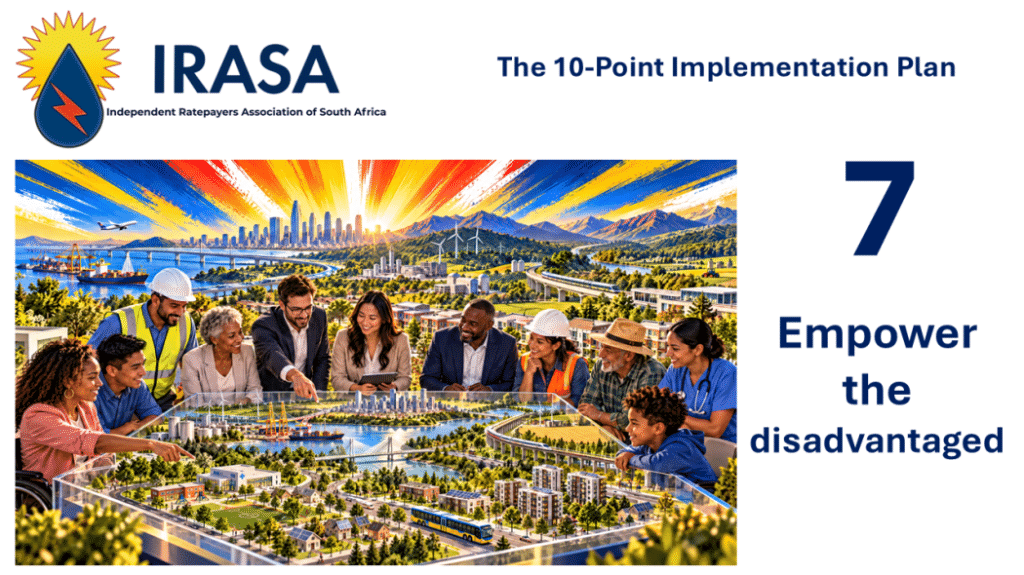
Our Role
Give disadvantaged residents a meaningful voice in decisions—not merely an invitation to a meeting.
Ten-Point Watchdog Manifesto
Give disadvantaged residents a meaningful voice by protecting transparent housing and beneficiary processes, monitoring services in neglected communities and ensuring genuine public participation before decisions are taken.
Action And Accountability Plan. IRASA Will:
- demand transparent housing and beneficiary lists;
- monitor services in informal settlements and historically neglected areas;
- promote accessible municipal services for older persons and persons with disabilities;
- strengthen public participation in languages and formats residents understand;
- support legitimate youth, women and community-development initiatives; and
- ensure that residents are consulted before decisions affecting their communities are finalised.
Proposed measurable community commitment
- Within 90 days, we will request publication of housing allocation criteria, application procedures and anonymised allocation statistics. Each quarter, we will report on access to that information and follow up on allocation complaints received.
- We will conduct at least two service-monitoring visits each month in informal settlements or historically neglected areas and request monthly progress on the priority problems identified.
- Every quarter, we will assess at least one municipal service point or service process for barriers affecting older residents and persons with disabilities, submit proposed improvements and follow up on unresolved barriers.
- For each consultation we organise, we will provide plain-language information in the main local languages identified for the audience and at least one accessible way to contribute. We will report participation and unanswered questions quarterly.
- Each quarter, we will meet at least one youth, women or community-development group to identify access barriers and support needs, then refer agreed requests to the appropriate municipal structure.
- For every major community-affecting decision placed before us, we will check whether consultation evidence is available, raise missing or inadequate consultation before voting, and report how resident input was addressed.
Evidence to report
- Requests and responses; quarterly statistics; complaint outcomes.
- Two monthly visits; priority issues; municipal progress and closures.
- Four assessments annually; improvements requested and implemented.
- Consultations held; language and access arrangements; feedback addressed.
- Four engagements annually; agreed requests; referrals and outcomes.
- Decisions checked; consultation concerns; recorded responses and votes.

Our Role
Council cannot promise everyone a job, but it can create an environment in which residents and businesses can create opportunities.
Ten-Point Watchdog Manifesto
Remove municipal barriers to job creation by challenging unnecessary red tape, supporting fair access to economic opportunities and monitoring whether development projects produce the jobs, skills and local benefits promised.
Action And Accountability Plan. IRASA Will:
- push for quicker, predictable processing of lawful business and development applications;
- identify and challenge unnecessary municipal red tape;
- promote fair access to municipal procurement for qualifying small and emerging businesses;
- support apprenticeships, artisan development, internships and workplace experience;
- monitor whether economic-development projects produce the jobs and benefits promised; and
- promote safe, clean and properly serviced business areas.
Proposed measurable community commitment
- We will track at least five business or development applications each quarter, with applicants’ consent, or all if fewer are referred to us. We will compare actual processing time with published standards and escalate overdue cases.
- We will identify at least one unnecessary administrative barrier each quarter, consult affected applicants and submit a practical simplification proposal. We will report which proposals were accepted and any verified time or cost reduction.
- We will distribute a monthly digest of accessible municipal procurement opportunities, hold two supplier-information sessions annually and refer every substantiated access complaint received to the appropriate oversight channel.
- We will convene two employer and training-provider engagements annually and maintain a quarterly list of verified apprenticeship, artisan, internship and workplace-experience opportunities. We will report confirmed placements arising from these engagements.
- Each quarter, we will review at least two economic-development projects, or all if fewer are active, comparing promised jobs, training and local benefits with verified results and explaining any shortfall.
- We will conduct one business-area walkabout each month, record safety, cleanliness and service problems, refer them within five working days and report unresolved cases and corrective action quarterly.
Evidence to report
- Application samples; days taken; overdue cases and responses.
- Four proposals annually; decisions; verified time and cost changes.
- Monthly digests; two annual sessions; access complaints and outcomes.
- Two engagements; four opportunity updates; confirmed placements.
- Project reviews; promised versus verified jobs and other benefits.
- Twelve walkabouts annually; referrals; quarterly case outcomes.
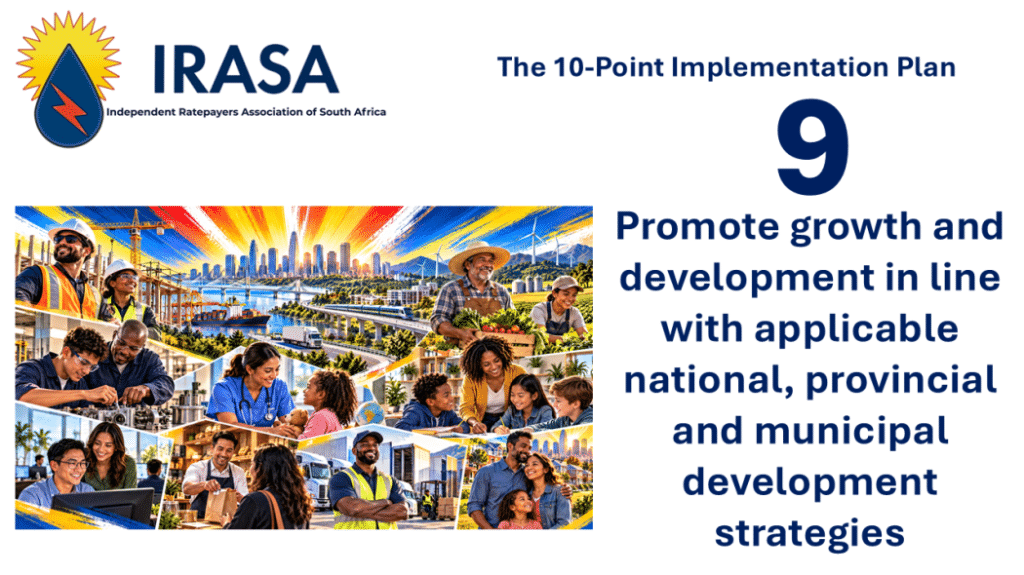
Our Role
Support growth that is planned, funded and beneficial—not growth that leaves residents with the bill.
Ten-Point Watchdog Manifesto
Ensure that growth is properly planned and funded by testing developments against infrastructure capacity, municipal development plans and environmental requirements, while protecting existing residents from carrying unfair development costs.
Action And Accountability Plan. IRASA Will:
- test development proposals against the IDP, spatial-development framework and infrastructure capacity;
- insist that development does not unfairly shift infrastructure costs onto existing ratepayers;
- monitor developer contributions and municipal commitments;
- support development that creates sustainable economic and community benefits;
- protect environmental resources and disaster-resilience requirements; and
- publish progress against approved development plans.
Proposed measurable community commitment
- For every major development proposal placed before us, we will check alignment with the IDP, spatial-development framework and available infrastructure-capacity evidence and publish our voting reasons within ten working days.
- For every major development proposal placed before us, we will request a breakdown of infrastructure costs and who will pay, question unsupported costs to existing ratepayers and report the municipality’s recorded decision.
- Each quarter, we will review at least three active developer or municipal infrastructure commitments, or all if fewer, checking agreed amounts, due dates and delivery, and question overdue obligations.
- For each major development proposal placed before us, we will request measurable employment, economic and community-benefit commitments. Each quarter, we will review delivery on at least two approved developments, or all if fewer are active.
- For every major development proposal placed before us, we will request available environmental and disaster-risk assessments and challenge missing safeguards. We will follow up quarterly on recorded unresolved concerns.
- We will publish one development-progress update each quarter covering the priority approved developments we monitor, their milestones, municipal commitments, delays and benefits confirmed to date.
Evidence to report
- Proposal checks; identified gaps; voting reasons and dates.
- Cost breakdowns requested; questions; payer allocations and decisions.
- Three quarterly checks; amounts due and received; overdue delivery.
- Commitments requested; two quarterly benefit reviews; verified results.
- Assessments checked; safeguards requested; quarterly responses.
- Four updates annually; milestones achieved, delayed or unverified.
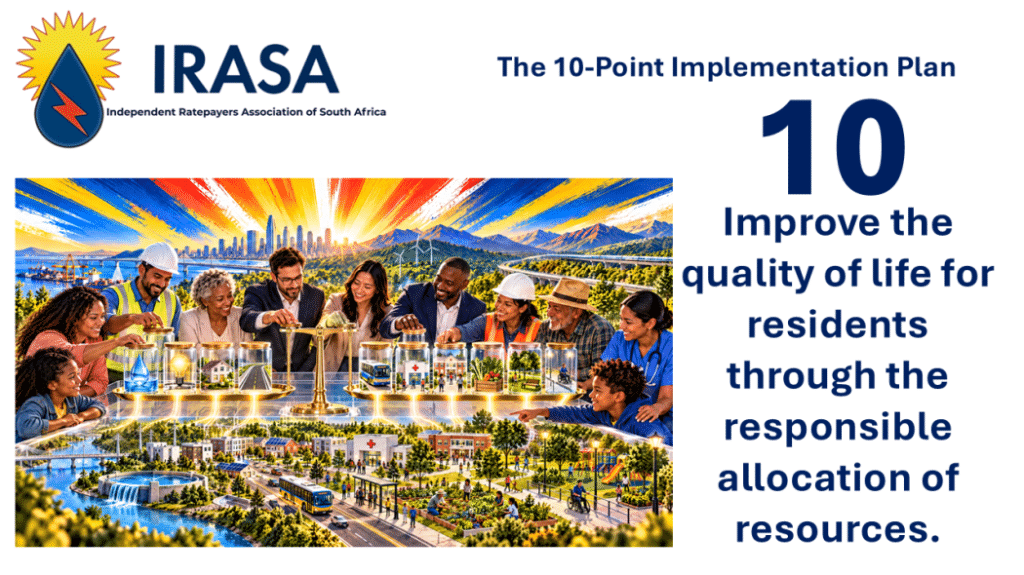
Our Role
Ensure that municipal resources improve everyday life—clean neighbourhoods, safe public spaces, working infrastructure and responsive services.
Ten-Point Watchdog Manifesto
Make the municipality answerable to its residents by monitoring budgets, projects, deadlines and outcomes, voting against unjustified expenditure and reporting back to communities at least quarterly.
Action And Accountability Plan. IRASA Will:
- assess whether the municipal budget reflects residents’ actual priorities;
- question non-essential expenditure before approving additional spending;
- monitor project costs, deadlines and final outcomes;
- require clear performance indicators for major programmes;
- vote against wasteful or inadequately motivated expenditure; and
Proposed measurable community commitment
- Before the annual budget vote, we will hold at least two resident budget discussions, collect priorities through an accessible additional channel and submit the five most frequently raised priorities with our budget response.
- For each additional spending proposal placed before us, we will request its purpose, cost, funding source and expected benefit. We will question proposals lacking that information and record our voting reasons.
- We will maintain a register of at least five priority municipal projects, or all if fewer are relevant, review it monthly and report approved versus actual costs, deadlines and confirmed outcomes every quarter.
- For each major programme placed before us, we will request a baseline, target, responsible department and reporting timetable before supporting it. We will review reported performance quarterly and question missing evidence.
- We will vote against expenditure we consider wasteful or inadequately justified, explain each such vote publicly within ten working days and report whether proposed corrections or savings were adopted.
- Within 30 days of each quarter ending, we will publish a resident report showing service cases, expenditure concerns, projects monitored, our actions, confirmed outcomes and outstanding matters, with a date for the next follow-up.
Evidence to report
- Two discussions; submissions received; five priorities and budget response.
- Proposals checked; information gaps; questions and votes.
- Monthly register updates; quarterly cost, time and outcome comparisons.
- Programmes checked; measures requested; quarterly performance reviews.
- Votes and reasons; publication dates; adopted corrections and savings.
- Four reports annually; publication dates; actions, outcomes and next steps.
Proposed improvement goals and measurement rules
These percentage goals supplement the action commitments. Establish the baseline within the first 90 days, using the previous 12 months where reliable data exists. Propose the targets to the municipality and confirm scope, resources and measurement before adopting them. Report quarterly and explain missed targets. These are proposed municipal improvement goals rather than guaranteed results from a councillor acting alone.
Fewer repeat complaints
Propose a 10% reduction over the following 12 months in repeat complaints concerning the same unresolved fault in monitored service categories.
Measurement: Compare equivalent periods and service coverage; publish total and repeat complaints separately. Keep reporting channels open and verify closures with residents where possible.
Lower controllable expenditure
Propose a 5% reduction over the following 12 months in selected discretionary cost categories identified through the expenditure review.
Measurement: Confirm a like-for-like baseline, inflation and workload effects, once-off costs and service quality. Count only documented realised savings; show them in rand and percentage terms.
Faster application processing
Propose a 10% reduction over the following 12 months in median processing time for a selected application category.
Measurement: Measure working days from a complete application to a decision; report sample size, pending cases and any exclusions. Separate approval rates from processing speed.
Lower water and electricity losses
Within 90 days, request separate water-loss and electricity-loss baselines. Propose realistic annual reduction targets once technical causes, investment and data quality are established.
Measurement: Report water and electricity separately using consistent definitions. Distinguish relative percentage reduction from percentage-point change. Do not announce a fixed loss target before the baseline is verified.
How we will report to residents
For each commitment, our quarterly report will show the target, work completed, municipal response, confirmed result, outstanding issue and next follow-up date. We will distinguish an action taken from a problem resolved. Where no eligible cases or projects existed, we will report that fact instead of claiming the target was achieved.
Monthly means calendar month; quarterly means every three months. The commitments apply to each elected IRASA representative and the ward or community they serve, with shared registers where practical.
Councillors can commit to checks, questions, referrals, votes and public reporting. Repairs, savings, allocations and other municipal results will be reported as confirmed outcomes. Where records are unavailable, we will record the request, response and resulting information gap. Personal information and confidential records will be excluded from public reports.

ONAFHANKLIKE BELASTINGBETALERSVERENIGING VAN SUID-AFRIKA (IRASA)
Manifes
IRASA, deur sy onafhanklike raadslede, is daartoe verbind om te veg vir die regte van belastingbetalers en inwoners, en om plaaslike regering in Suid-Afrika te de-politiseer. Dit is ons gesamentlike verantwoordelikheid as belastingbetalers om ons demokratiese reg en burgerlike plig uit te oefen deur as ‘n waghond op te tree oor die politieke partye wat ons stede en dorpe regeer. Belastingbetalers kan nie agterweë staan terwyl munisipaliteite agteruitgaan onder die agendas en politieke speletjies van hierdie partye nie. Dit is ‘n bekende feit dat politieke party-raadslede die party lyn moet volg en hul party se agenda bo die belange van die gemeenskap en die belastingbetalers wat hulle verkies is om te dien, moet prioritiseer. Moet nie jou stem mors op ‘n politieke party-politikus nie. Neem jou mag terug – ondersteun die kandidaat van die belastingbetalers!
IRASA sal verseker dat munisipaliteite nasionaal doeltreffend, doeltreffend, deursigtig en op ‘n finansieel aanspreeklike wyse bestuur word, in ooreenstemming met die bepalings van plaaslike regerings wetgewing. Die onafhanklike raadslede sal deur IRASA die regverdige en billike verspreiding van munisipale dienste bevorder, en verseker dat dienslewering betroubaar, bekostigbaar en van volhoubare gehalte is. Deur verantwoordelike burgerskap uit te oefen – met die belastingbetaler eerste – sal IRASA die waardigheid en diens gehalte van stede en dorpe in Suid-Afrika herstel. Sterk, onafhanklike tarief betaler verteenwoordiging kan net ons munisipaliteite vorentoe versterk.
IRASA HOU SY EIE VERTEENWOORDIGERS AANSPREEKLIK
IRASA glo dat aanspreeklikheid by sy eie verteenwoordigers moet begin. Elke IRASA-kandidaat sal ‘n deursigtige keurings- en keuringsproses ondergaan en, sodra dit goedgekeur is, as ‘n Geakkrediteerde IRASA-kandidaat erken word. Elke verkose IRASA-raadslid sal ‘n Prestasie-ooreenkoms onderteken, ‘n jaarlikse belange verklaring indien, jaarlikse etiek- en bestuur opleiding ondergaan, en gemeet word aan die hand van gepubliseerde Sleutelprestasie-aanwysers (KPI’s).
Elke IRASA-wyk sal minstens kwartaalliks aan sy inwoners verslag doen oor prestasie, diensleweringsprioriteite en sake wat die gemeenskap raak. Elke verkose raadslid sal ‘n jaarlikse bestuur gradering ontvang gebaseer op meetbare standaarde van bywoning, aanspreeklikheid, etiese gedrag, gemeenskapsbetrokkenheid en prestasie.
IRASA sal nie standaarde van deursigtigheid, aanspreeklikheid en goeie bestuur van munisipaliteite eis wat dit nie op sy eie verteenwoordigers wil toepas nie.
Die mandaat wat kiesers aan IRASA gee, sal nie net verantwoordelike plaaslike regering verseker nie, maar dit sal ook ons demokrasie bevorder, eerder as om dit te beperk, deur verantwoordelike, onafhanklike toesig van belastingbetalers. IRASA sien voor dat dit dienslewering vir belastingbetalers sal verbeter en ‘n goed bestuurde plaaslike regerings omgewing sal skep wat plaaslike ekonomiese ontwikkeling kan stimuleer om die ekonomiese uitdagings wat munisipaliteite in Suid-Afrika in die gesig staar, aan te spreek.
IRASA HET 'N TIENPUNTPLAN OM PLAASLIKE REGERING TE LAAT WERK
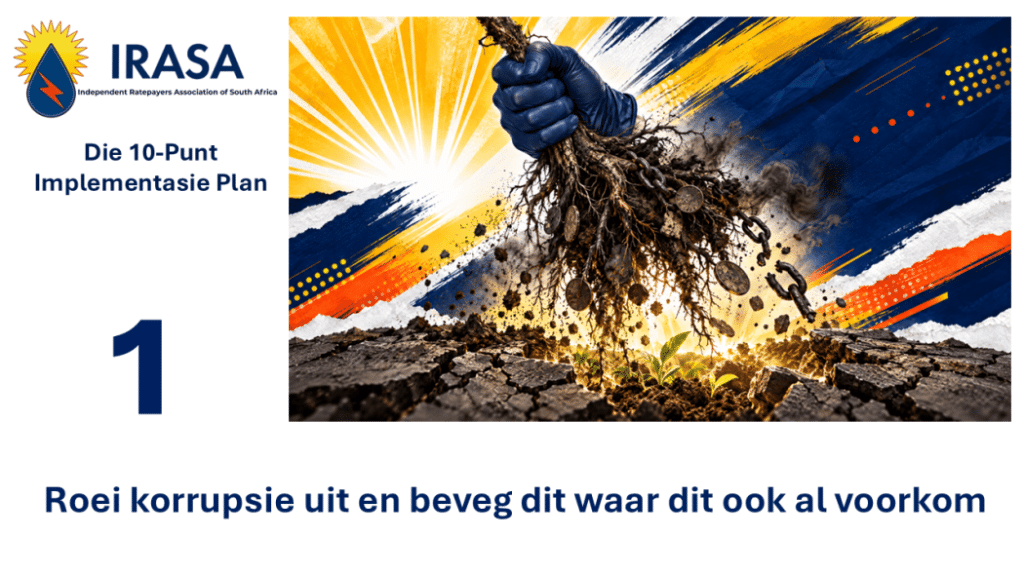
Ons Rol:
Volg die geld, eis die rekords en sorg dat oortredings nie stilweg toegesmeer word nie.
Tienpuntmanifes vir ons waghond-rol:
Lê korrupsie bloot en beskerm openbare geld deur toegekende tenders, belangebotsings, kontrakwysigings en kontrakteurprestasie te ondersoek, en geloofwaardige bewyse van oortredings na die toepaslike owerhede te verwys.
Aksie en verantwoordbaarheidsplan. IRASA sal:
- versterk terugwerkende toesig oor verkryging deur MPAC;
- ondersoek toegekende tenders, pryse, mededingende bodaanbiedinge, kontrakteurs, wysigings en prestasie;
- vereis verklarings van belange en die onttrekking van raadslede of amptenare met botsende belange;
- verwys geloofwaardige bewyse van wangedrag na die toepaslike toesig- of wetstoepassingsowerheid; en
- doen openbaar verslag oor of ondersoeke tot gevolge gelei het.
Voorgestelde meetbare verbintenis aan die gemeenskap:
- Ons sal bevindings oor verkrygingstoesig elke kwartaal hersien, skriftelike vrae oor elke onopgeloste prioriteitsbevinding indien en maandeliks opvolg totdat ’n antwoord of aangetekende besluit ontvang is.
- Ons sal elke maand minstens drie toegekende kontrakte ondersoek, of almal indien minder beskikbaar is, en pryse, mededingende bodaanbiedinge, kontrakteurs, wysigings en lewering nagaan. Ons sal die getal ondersoekte kontrakte en aangetekende bekommernisse rapporteer.
- Voor elke toepaslike raads- of komiteebesluit sal ons beskikbare belangeverklarings nagaan en elke geïdentifiseerde moontlike belangebotsing opper. Ons sal onttrekking versoek waar toepaslik en die reaksie aanteken.
- Ons sal elke gestaafde verslag van wangedrag beoordeel en geloofwaardige bewyse binne tien werksdae ná voltooiing van ons beoordeling na die toepaslike owerheid verwys. Ons sal elke oop verwysing maandeliks opvolg.
- Elke kwartaal sal ons verslag doen oor die status van alle sake wat ons verwys het, met inbegrip van reaksies, ondersoeke, besluite en enige verhaling of dissiplinêre optrede wat die verantwoordelike owerheid bevestig het.
Bewyse vir verslagdoening:
- Kwartaalhersienings; vrae, antwoorde en uitstaande bevindings.
- Kontrakhersieningsregister; kwartaallikse opsomming van bevindings.
- Voltooide kontroles; belangebotsings geopper; reaksies en aangetekende onttrekkings.
- Beoordelings- en verwysingsdatums; ontvangserkennings; maandelikse status.
- Vier verslae per jaar; sake met bevestigde uitkomste of hangende status.
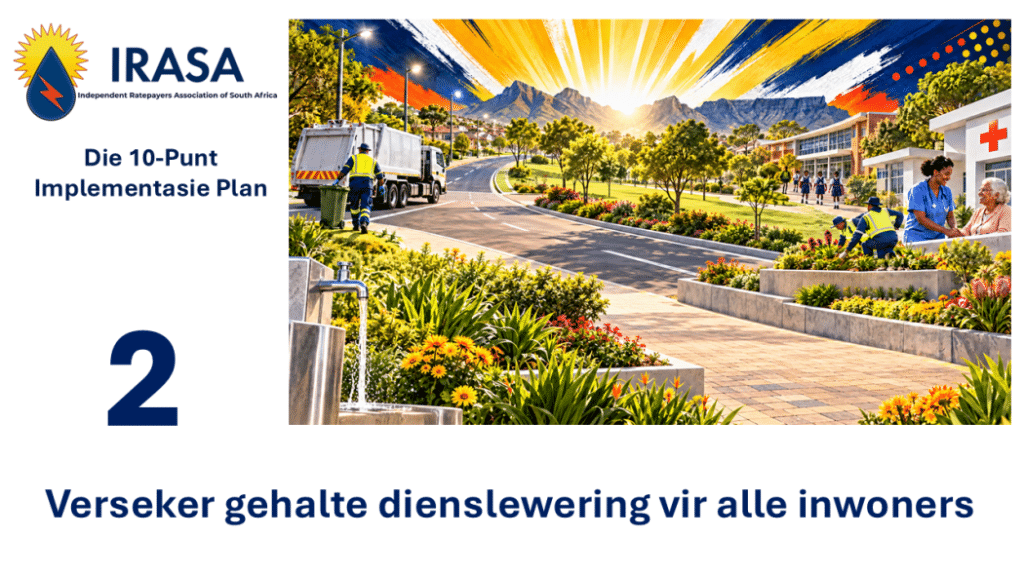
Ons Rol:
Omskep klagtes in opgevolgde sake, met name, datums en meetbare uitkomste.
Tienpuntmanifes vir ons waghond-rol:
Volg dienslewering in elke wyk deur klagtes aan te teken, verantwoordelikheid toe te wys, sperdatums te monitor en openbaar verslag te doen oor wat opgelos is — en wat nie.
Aksie en verantwoordbaarheidsplan. IRASA sal:
- stel wykgebaseerde diensleweringsregisters op;
- teken klagtes, verantwoordelike departemente, sperdatums en uitkomste aan;
- vergelyk werklike prestasie met die GOP, begroting en Dienslewerings- en Begrotingsimplementeringsplan;
- identifiseer gemeenskappe wat ongelyke of onvoldoende dienste ontvang; en
- doen minstens kwartaalliks aan inwoners verslag.
Voorgestelde meetbare verbintenis aan die gemeenskap:
- Binne 60 dae ná ampsaanvaarding sal ons ’n diensleweringsregister vir ons wyk opstel. Ons sal dit weekliks bywerk en elke maand ’n geanonimiseerde opsomming publiseer.
- Ons sal elke klagte binne twee werksdae ná ontvangs aanteken, dit binne drie erken en dit binne vyf na die verantwoordelike departement verwys. Ons sal ’n afhandelingsdatum versoek en onopgeloste sake minstens maandeliks opvolg.
- Elke kwartaal sal ons gerapporteerde lewering met minstens vyf wykverwante GOP-, begrotings- of SDBIP-verbintenisse vergelyk, skriftelike vrae oor teikens wat nie bereik is nie indien en regstellende optrede versoek.
- Elke kwartaal sal ons minstens drie gebiede met onvoldoende dienslewering beoordeel, of almal indien minder bestaan, deur besoeke, klagterekords en beskikbare diensdata te gebruik. Ons sal ’n geprioritiseerde lys tekortkominge vir munisipale optrede indien.
- Ons sal elke jaar vier inwonerverslae uitreik en minstens een toeganklike openbare terugvoersessie per kwartaal hou, met besonderhede oor voltooide werk, verbintenisse wat nie nagekom is nie en onopgeloste sake.
Bewyse vir verslagdoening:
- Register se bekendstellingsdatum; weeklikse bywerkings; maandelikse opsommings.
- Aantekenings-, erkennings- en verwysingstye; uitkomste en agterstallige sake.
- Vyf vergelykings per kwartaal; afwykings, vrae en reaksies.
- Gebiede beoordeel; diensgapings; versoeke en opvolguitkomste.
- Vier verslae en vier terugvoersessies per jaar.
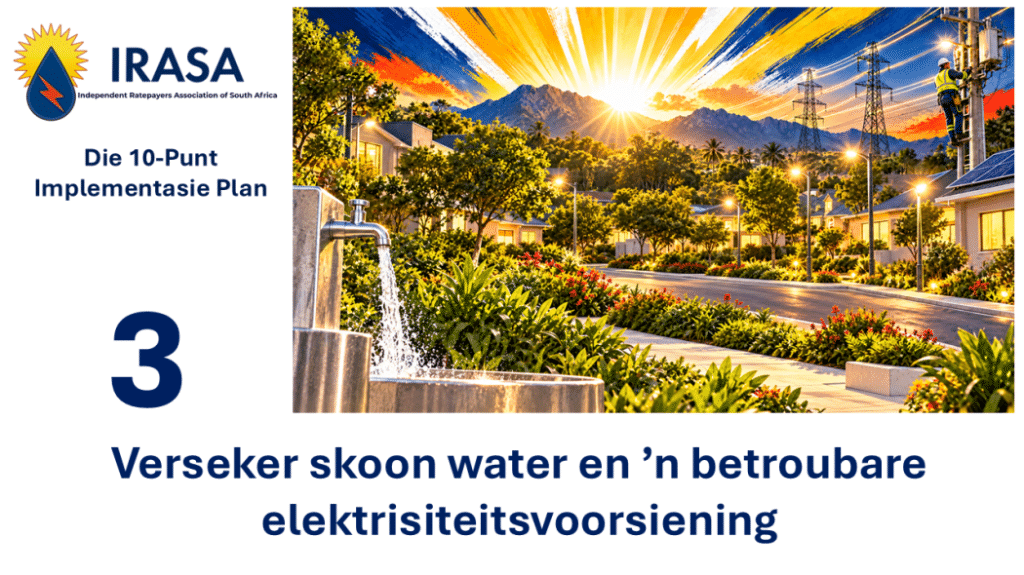
Ons Rol:
Verseker dat instandhouding plaasvind voordat infrastruktuur ’n krisispunt bereik.
Tienpuntmanifes vir ons waghond-rol:
Beskerm water- en elektrisiteitsdienste deur onderbrekings, infrastruktuurfoute, water- en elektrisiteitsverliese, instandhoudingsplanne en die munisipaliteit se gereedheid vir toekomstige groei en noodgevalle te monitor.
Aksie en verantwoordbaarheidsplan. IRASA sal:
- monitor waterverliese, elektrisiteitsverliese, onderbrekings en infrastruktuurfoute;
- vereis befondsde instandhoudings- en vervangingsplanne;
- ondersoek projekte vir watersekerheid, droogtereaksie en alternatiewe energie;
- vereis assesserings van infrastruktuurkapasiteit voordat groot ontwikkelings goedgekeur word; en
- monitor of projekte betyds, binne begroting en volgens die vereiste standaard voltooi word.
Voorgestelde meetbare verbintenis aan die gemeenskap:
- Ons sal elke maand minstens vyf gedokumenteerde kontroles oor waterverliese, elektrisiteitsverliese, onderbrekings en infrastruktuurfoute voltooi. Ons sal kwartaalliks bygewerkte verliessyfers versoek en die frekwensie en duur van onderbrekings en herhalende foute rapporteer waar data beskikbaar is.
- Binne 90 dae sal ons befondsde instandhoudings- en vervangingskedules vir prioriteitsinfrastruktuur versoek. Elke kwartaal sal ons minstens vyf geskeduleerde items nagaan, of almal indien minder bestaan, en onbefondsde of vertraagde werk bevraagteken.
- Elke kwartaal sal ons minstens twee aktiewe projekte vir watersekerheid, droogtereaksie of alternatiewe energie hersien, of almal indien minder bestaan, en befondsing, mylpale, verwagte voordele en implementeringsrisiko’s nagaan.
- Vir elke groot ontwikkelingsvoorstel wat aan ons voorgelê word, sal ons voor stemming bewyse van water-, elektrisiteits- en ander infrastruktuurkapasiteit versoek. Ons sal ontbrekende bewyse en ons gevolglike standpunt aanteken.
- Elke kwartaal sal ons minstens drie prioriteitsinfrastruktuurprojekte nagaan, of almal indien minder bestaan, teen goedgekeurde koste, sperdatums en gedokumenteerde gehaltevereistes, en regstellende optrede vir elke geïdentifiseerde afwyking versoek.
Bewyse vir verslagdoening:
- Vyf maandelikse kontroles; kwartaallikse verliesdata; fout- en onderbrekingstendense.
- Skedules versoek; befondsingsgapings; vyf items kwartaalliks nagegaan.
- Projekhersienings; mylpaalafwykings; vrae en antwoorde.
- Voorstelle hersien; kapasiteitsbewyse versoek; stemredes.
- Koste- en sperdatumafwykings; inspeksie- of sertifiseringsbewyse.

Ons Rol:
Sorg dat elke rand wat van inwoners ingevorder word, ’n verdedigbare doel en ’n meetbare resultaat het.
Tienpuntmanifes vir ons waghond-rol:
Beskerm inwoners teen onbekostigbare eiendomsbelasting deur tariefverhogings te ondersoek, verkwistende uitgawes te bevraagteken en meetbare waarde te vereis vir elke rand wat van inwoners ingevorder word.
Aksie en verantwoordbaarheidsplan. IRASA sal:
- ondersoek tariefverhogings en die uitwerking daarvan op huishoudings en ondernemings;
- bevraagteken onnodige of swak gemotiveerde uitgawes;
- vergelyk munisipale koste met dié van soortgelyke munisipaliteite;
- beskerm toepaslike kortings vir pensioenarisse, behoeftige huishoudings en persone met gestremdhede;
- vereis meetbare waarde van konsultante, kontrakteurs en munisipale projekte; en
- staan begrotings teen wat ondoeltreffendheid op betalende inwoners afskuif.
Voorgestelde meetbare verbintenis aan die gemeenskap:
- Vir elke jaarlikse tariefvoorstel sal ons voor die raadsstemming ’n impakvergelyking publiseer met minstens vier voorbeeldrekeninge vir huishoudings en ondernemings. Ons sal persentasie- en randveranderings verduidelik en bekostigbaarheidskwessies indien.
- Ons sal elke kwartaal minstens drie diskresionêre uitgawe-items beoordeel, of almal indien minder voorgelê word, en dié sonder ’n duidelike behoefte of voordeel bevraagteken. Ons sal geverifieerde besparings uit veranderings wat die munisipaliteit aanvaar het, rapporteer.
- Een keer per jaar sal ons minstens vyf beskikbare tarief- of eenheidskostemaatstawwe met drie breedweg vergelykbare munisipaliteite vergelyk en verskille in diensomvang verduidelik voordat ons verbeterings voorstel.
- Voor elke jaarlikse begrotingstemming sal ons kortings- en behoeftigeondersteuningsvoorstelle hersien en bekommernisse oor verminderings of toegangsversperrings indien. Ons sal twee inligtingsessies per jaar hou en hulpversoeke tot ’n aangetekende uitkoms opvolg.
- Elke kwartaal sal ons minstens drie konsultantopdragte, kontrakte of munisipale projekte ondersoek, of almal indien minder bestaan, en fooie met ooreengekome lewerings en aanvaardingsbewyse vergelyk. Ons sal onvoltooide of ongestaafde werk bevraagteken.
- By elke jaarlikse en aansuiweringsbegrotingsbesluit sal ons ongestaafde koste of voorgestelde afskuiwing van vermybare ondoeltreffendheid op inwoners identifiseer, wysigingsvoorstelle indien en ons stemredes binne tien werksdae publiseer.
Bewyse vir verslagdoening:
- Jaarlikse vergelyking; vier voorbeeldrekeninge; kwessies ingedien.
- Items beoordeel; besware; aanvaarde veranderings en geverifieerde randbesparings.
- Jaarlikse vergelyking; vyf maatstawwe; drie vergelykingsmunisipaliteite waar data bestaan.
- Jaarlikse hersiening; twee sessies; aansoeke ondersteun en uitkomste.
- Voltooide hersienings; fooie, lewerings en aanvaardingsbewyse.
- Wysigings ingedien; besluite; stemredes en publikasiedatums.

Ons Rol:
Vervang herhaalde klagtes en tydelike lapwerk met beplande, verifieerbare instandhouding.
Tienpuntmanifes vir ons waghond-rol:
Hou die munisipaliteit verantwoordbaar vir paaie en slaggate deur ’n openbare padtoestandregister, deursigtige herstelprioriteite, behoorlike vakmanskap en voorkomende instandhouding te vereis.
Aksie en verantwoordbaarheidsplan. IRASA sal:
- versoek ’n openbaar toeganklike register van padtoestande en slaggate;
- vereis deursigtige kriteria vir die prioritisering van padherstelwerk;
- volg gerapporteerde gebreke vanaf registrasie tot afhandeling;
- inspekteer of herstelwerk aan ’n aanvaarbare standaard voldoen;
- monitor besteding aan paaie, stormwaterstelsels en voorkomende instandhouding; en
- eskaleer provinsiale of nasionale padprobleme na die korrekte owerheid.
Voorgestelde meetbare verbintenis aan die gemeenskap:
- Binne 90 dae sal ons ’n versoek vir ’n openbare register van padtoestande en slaggate ter tafel lê. Totdat ’n munisipale register beskikbaar is, sal ons ons eie wyklys van gebreke byhou en maandeliks ’n bygewerkte opsomming publiseer.
- Binne 90 dae sal ons gepubliseerde kriteria vir herstelprioriteite versoek. Elke kwartaal sal ons minstens tien aangetekende gebreke, of almal indien minder bestaan, met die herstelvolgorde vergelyk en onverklaarde afwykings bevraagteken.
- Ons sal elke padgebrek wat aan ons gerapporteer word binne twee werksdae aanteken, dit binne vyf by die verantwoordelike owerheid indien en onopgeloste sake maandeliks nagaan. Elke kwartaal sal ons afhandelingskoerse en die tydsduur rapporteer.
- Ons sal elke maand minstens vyf voltooide herstelwerke inspekteer, of almal indien minder toeganklik is, en sigbare gebreke binne vyf werksdae rapporteer. Waar vakmanskap betwis word, sal ons ’n tegniese beoordeling versoek.
- Elke kwartaal sal ons besteding en vordering teen die begrotings vir paaie, stormwater en voorkomende instandhouding hersien en vrae oor vertragings, onverklaarde onderbesteding en oorbesteding indien.
- Ons sal elke provinsiale of nasionale padprobleem wat aan ons gerapporteer word binne vyf werksdae na die korrekte owerheid verwys en maandeliks opvolg totdat ’n reaksie of aksie aangeteken is.
Bewyse vir verslagdoening:
- Versoek- en reaksiedatums; maandelikse opsommings van gebreke.
- Kriteria versoek; tien vergelykings kwartaalliks; afwykings verduidelik.
- Datums van gebreke; verwysings; afhandelings; persentasie opgelos en dae geneem.
- Vyf herstelkontroles; foto’s; gebreke verwys en reaksies.
- Kwartaallikse begrotingsvergelykings; vrae en regstellende reaksies.
- Verwysingsdatums; maandelikse opvolg; reaksies en bevestigde herstelwerk.

Ons Rol:
Verseker dat hulp diegene bereik wat kwalifiseer, sonder politieke begunstiging
Tienpuntmanifes vir ons waghond-rol:
Verseker dat armoedeverligtingsmaatreëls die mense bereik wat dit nodig het deur ondersteuning vir behoeftiges, gratis basiese dienste en die regverdige verdeling van munisipale hulpbronne oor alle gemeenskappe te monitor.
Aksie en verantwoordbaarheidsplan. IRASA sal:
- monitor toegang tot ondersteuning vir behoeftiges en gratis basiese dienste;
- ondersoek of munisipale hulpbronne regverdig tussen gemeenskappe verdeel word;
- beskerm basiese dienste in kwesbare en informele gemeenskappe;
- ondersteun inisiatiewe vir voedselsekerheid, vaardigheidsontwikkeling en gemeenskapsondernemings binne die munisipale mandaat; en
- verseker dat armoedeverligtingsprogramme kwalifiserende inwoners bereik eerder as begunstigdes met politieke verbintenisse.
Voorgestelde meetbare verbintenis aan die gemeenskap:
- Ons sal elke kwartaal een hulpsessie oor ondersteuning vir behoeftiges hou, minstens vyf gerapporteerde toegangsprobleme per maand hersien waar sake beskikbaar is, en aansoeke en kwessies oor gratis basiese dienste tot ’n aangetekende uitkoms opvolg.
- Elke kwartaal sal ons minstens drie beskikbare diens- of bestedingsmaatstawwe oor drie wykgebiede vergelyk, of alle gebiede indien minder bestaan, en verskille bevraagteken wat nie deur behoefte of diensomstandighede verklaar word nie.
- Ons sal elke maand minstens twee besoeke aan kwesbare of informele gemeenskappe doen, gapings in noodsaaklike dienste aanteken en dringende probleme binne een werksdag verwys. Ons sal alle oop sake maandeliks opvolg.
- Ons sal elke kwartaal met minstens een toepaslike inisiatief vir voedselsekerheid, vaardighede of gemeenskapsondernemings skakel, praktiese munisipale ondersteuning identifiseer en rapporteer of die versoekte ondersteuning en beoogde voordele bereik is.
- Elke kwartaal sal ons die kwalifiseringskriteria en klagteproses van minstens een aktiewe armoedeverligtingsprogram hersien en elke gestaafde verslag van onregverdige uitsluiting of begunstiging wat ons ontvang, beoordeel.
Bewyse vir verslagdoening:
- Vier sessies per jaar; sake hersien; aansoeke en uitkomste.
- Gebiedsvergelykings; maatstawwe gebruik; ongelykhede en verduidelikings.
- Twee maandelikse besoeke; dringende verwysings; oop en opgeloste sake.
- Vier skakelings per jaar; ondersteuning versoek; voordele bevestig.
- Programhersienings; klagtes beoordeel; verwysings en uitkomste.

Ons Rol:
Gee benadeelde inwoners ’n betekenisvolle stem in besluite — nie bloot ’n uitnodiging na ’n vergadering nie.
Tienpuntmanifes vir ons waghond-rol:
Gee benadeelde inwoners ’n betekenisvolle stem deur deursigtige behuisings- en begunstigdeprosesse te beskerm, dienste in verwaarloosde gemeenskappe te monitor en daadwerklike openbare deelname te verseker voordat besluite geneem word.
Aksie en verantwoordbaarheidsplan. IRASA sal:
- vereis deursigtige behuisings- en begunstigdelys;
- monitor dienste in informele nedersettings en histories verwaarloosde gebiede;
- bevorder toeganklike munisipale dienste vir ouer persone en persone met gestremdhede;
- versterk openbare deelname in tale en formate wat inwoners verstaan;
- ondersteun regmatige jeug-, vroue- en gemeenskapsontwikkelingsinisiatiewe; en
- verseker dat inwoners geraadpleeg word voordat besluite wat hul gemeenskappe raak, gefinaliseer word.
Voorgestelde meetbare verbintenis aan die gemeenskap:
- Binne 90 dae sal ons die publikasie van behuisingstoekenningskriteria, aansoekprosedures en geanonimiseerde toekenningstatistiek versoek. Elke kwartaal sal ons verslag doen oor toegang tot dié inligting en toekenningsklagtes opvolg.
- Ons sal elke maand minstens twee diensmoniteringsbesoeke aan informele nedersettings of histories verwaarloosde gebiede doen en maandelikse vordering oor geïdentifiseerde prioriteitsprobleme versoek.
- Elke kwartaal sal ons minstens een munisipale dienspunt of diensproses beoordeel vir versperrings wat ouer inwoners en persone met gestremdhede raak, verbeteringsvoorstelle indien en onopgeloste versperrings opvolg.
- Vir elke raadpleging wat ons reël, sal ons inligting in gewone taal verskaf in die belangrikste plaaslike tale wat vir die gehoor geïdentifiseer is, met minstens een toeganklike manier om insette te lewer. Ons sal deelname en onbeantwoorde vrae kwartaalliks rapporteer.
- Elke kwartaal sal ons met minstens een jeug-, vroue- of gemeenskapsontwikkelingsgroep vergader om toegangsversperrings en ondersteuningsbehoeftes te identifiseer, en ooreengekome versoeke na die toepaslike munisipale struktuur verwys.
- Vir elke groot besluit wat die gemeenskap raak en aan ons voorgelê word, sal ons nagaan of raadplegingsbewyse beskikbaar is, ontbrekende of onvoldoende raadpleging voor stemming opper en rapporteer hoe inwoners se insette hanteer is.
Bewyse vir verslagdoening:
- Versoeke en reaksies; kwartaallikse statistiek; klagte-uitkomste.
- Twee maandelikse besoeke; prioriteitskwessies; munisipale vordering en afhandelings.
- Vier assesserings per jaar; verbeterings versoek en geïmplementeer.
- Raadplegings gehou; taal- en toegangsreëlings; terugvoer hanteer.
- Vier skakelings per jaar; ooreengekome versoeke; verwysings en uitkomste.
- Besluite nagegaan; raadplegingskwessies; aangetekende reaksies en stemme.

Ons Rol:
Die raad kan nie vir almal ’n werk belowe nie, maar kan ’n omgewing skep waarin inwoners en ondernemings geleenthede kan skep.
Tienpuntmanifes vir ons waghond-rol:
Verwyder munisipale struikelblokke vir werkskepping deur onnodige rompslomp te bevraagteken, regverdige toegang tot ekonomiese geleenthede te ondersteun en te monitor of ontwikkelingsprojekte die beloofde werkgeleenthede, vaardighede en plaaslike voordele oplewer.
Aksie en verantwoordbaarheidsplan. IRASA sal:
- bevorder vinniger, voorspelbare verwerking van wettige sake- en ontwikkelingsaansoeke;
- identifiseer en bevraagteken onnodige munisipale rompslomp;
- bevorder regverdige toegang tot munisipale verkryging vir kwalifiserende klein en opkomende ondernemings;
- ondersteun vakleerlingskappe, ambagsontwikkeling, internskappe en werkplekervaring;
- monitor of ekonomiese ontwikkelingsprojekte die beloofde werkgeleenthede en voordele oplewer; en
- bevorder veilige, skoon en behoorlik bediende sakegebiede.
Voorgestelde meetbare verbintenis aan die gemeenskap:
- Ons sal elke kwartaal minstens vyf sake- of ontwikkelingsaansoeke met die aansoekers se toestemming opvolg, of almal indien minder na ons verwys word. Ons sal werklike verwerkingstyd met gepubliseerde standaarde vergelyk en agterstallige sake eskaleer.
- Ons sal elke kwartaal minstens een onnodige administratiewe versperring identifiseer, geraakte aansoekers raadpleeg en ’n praktiese vereenvoudigingsvoorstel indien. Ons sal rapporteer watter voorstelle aanvaar is en enige geverifieerde tyd- of kostevermindering.
- Ons sal ’n maandelikse opsomming van toeganklike munisipale verkrygingsgeleenthede versprei, twee verskafferinligtingsessies per jaar hou en elke gestaafde toegangsklagte na die toepaslike toesigkanaal verwys.
- Ons sal twee skakelings met werkgewers en opleidingsverskaffers per jaar reël en kwartaalliks ’n lys van geverifieerde vakleerlingskap-, ambags-, internskap- en werkplekervaringsgeleenthede byhou. Ons sal bevestigde plasings wat uit dié skakelings voortvloei, rapporteer.
- Elke kwartaal sal ons minstens twee ekonomiese ontwikkelingsprojekte hersien, of almal indien minder aktief is, beloofde werkgeleenthede, opleiding en plaaslike voordele met geverifieerde resultate vergelyk en enige tekort verduidelik.
- Ons sal elke maand een stapbesoek aan ’n sakegebied doen, veiligheids-, netheids- en diensprobleme aanteken, dit binne vyf werksdae verwys en onopgeloste sake en regstellende optrede kwartaalliks
Bewyse vir verslagdoening:
- Aansoeksteekproewe; dae geneem; agterstallige sake en reaksies.
- Vier voorstelle per jaar; besluite; geverifieerde tyd- en kosteveranderings.
- Maandelikse opsommings; twee jaarlikse sessies; toegangsklagtes en uitkomste.
- Twee skakelings; vier geleentheidsbywerkings; bevestigde plasings.
- Projekhersienings; beloofde teenoor geverifieerde werkgeleenthede en ander voordele.
- Twaalf stapbesoeke per jaar; verwysings; kwartaallikse saakuitkomste.

Ons Rol:
Ondersteun groei wat beplan, befonds en voordelig is — nie groei wat inwoners met die rekening laat nie.
Tienpuntmanifes vir ons waghond-rol:
Verseker dat groei behoorlik beplan en befonds is deur ontwikkelings aan infrastruktuurkapasiteit, munisipale ontwikkelingsplanne en omgewingsvereistes te toets, terwyl bestaande inwoners teen onregverdige ontwikkelingskoste beskerm word.
Aksie en verantwoordbaarheidsplan. IRASA sal:
- toets ontwikkelingsvoorstelle aan die GOP, ruimtelike ontwikkelingsraamwerk en infrastruktuurkapasiteit;
- dring daarop aan dat ontwikkeling nie infrastruktuurkoste onregverdig op bestaande belastingbetalers afskuif nie;
- monitor ontwikkelaarbydraes en munisipale verbintenisse;
- ondersteun ontwikkeling wat volhoubare ekonomiese en gemeenskapsvoordele skep;
- beskerm omgewingshulpbronne en vereistes vir rampveerkragtigheid; en
- publiseer vordering teen goedgekeurde ontwikkelingsplanne.
Voorgestelde meetbare verbintenis aan die gemeenskap:
- Vir elke groot ontwikkelingsvoorstel wat aan ons voorgelê word, sal ons belyning met die GOP, ruimtelike ontwikkelingsraamwerk en beskikbare infrastruktuurkapasiteitsbewyse nagaan en ons stemredes binne tien werksdae publiseer.
- Vir elke groot ontwikkelingsvoorstel wat aan ons voorgelê word, sal ons ’n uiteensetting van infrastruktuurkoste en wie dit sal betaal versoek, ongestaafde koste vir bestaande belastingbetalers bevraagteken en die munisipaliteit se aangetekende besluit rapporteer.
- Elke kwartaal sal ons minstens drie aktiewe ontwikkelaar- of munisipale infrastruktuurverbintenisse hersien, of almal indien minder bestaan, ooreengekome bedrae, sperdatums en lewering nagaan en agterstallige verpligtinge bevraagteken.
- Vir elke groot ontwikkelingsvoorstel wat aan ons voorgelê word, sal ons meetbare verbintenisse oor werkgeleenthede, ekonomiese en gemeenskapsvoordele versoek. Elke kwartaal sal ons lewering by minstens twee goedgekeurde ontwikkelings hersien, of almal indien minder aktief is.
- Vir elke groot ontwikkelingsvoorstel wat aan ons voorgelê word, sal ons beskikbare omgewings- en ramprisiko-assesserings versoek en ontbrekende beskermingsmaatreëls bevraagteken. Ons sal aangetekende onopgeloste kwessies kwartaalliks opvolg.
- Ons sal elke kwartaal een ontwikkelingsvorderingsverslag publiseer oor die prioriteitsontwikkelings wat ons monitor, hul mylpale, munisipale verbintenisse, vertragings en voordele wat tot op daardie stadium bevestig is.
Bewyse vir verslagdoening:
- Voorstelkontroles; geïdentifiseerde gapings; stemredes en datums.
- Koste-uiteensettings versoek; vrae; betalingsverantwoordelikheid en besluite.
- Drie kwartaalkontroles; bedrae verskuldig en ontvang; agterstallige lewering.
- Verbintenisse versoek; twee kwartaallikse voordeelhersienings; geverifieerde resultate.
- Assesserings nagegaan; beskermingsmaatreëls versoek; kwartaallikse reaksies.
- Vier bywerkings per jaar; mylpale bereik, vertraag of ongeverifieer.

Ons Rol:
Verseker dat munisipale hulpbronne die alledaagse lewe verbeter — skoon woonbuurte, veilige openbare ruimtes, werkende infrastruktuur en responsiewe dienste.
Tienpuntmanifes vir ons waghond-rol:
Laat die munisipaliteit aan sy inwoners verantwoording doen deur begrotings, projekte, sperdatums en uitkomste te monitor, teen ongeregverdigde uitgawes te stem en minstens kwartaalliks aan gemeenskappe verslag te doen.
Aksie en verantwoordbaarheidsplan. IRASA sal:
- beoordeel of die munisipale begroting inwoners se werklike prioriteite weerspieël;
- bevraagteken nie-noodsaaklike uitgawes voordat bykomende besteding goedgekeur word;
- monitor projekkoste, sperdatums en finale uitkomste;
- vereis duidelike prestasie-aanwysers vir groot programme;
- stem teen verkwistende of onvoldoende gemotiveerde uitgawes; en
- voorsien inwoners van kwartaalverslae oor dienslewering, besteding en onopgeloste sake.
Voorgestelde meetbare verbintenis aan die gemeenskap:
- Voor die jaarlikse begrotingstemming sal ons minstens twee begrotingsbesprekings met inwoners hou, prioriteite deur ’n bykomende toeganklike kanaal insamel en die vyf prioriteite wat die meeste geopper is, saam met ons begrotingsreaksie indien.
- Vir elke bykomende bestedingsvoorstel wat aan ons voorgelê word, sal ons die doel, koste, befondsingsbron en verwagte voordeel versoek. Ons sal voorstelle sonder dié inligting bevraagteken en ons stemredes aanteken.
- Ons sal ’n register van minstens vyf prioriteitsmunisipale projekte byhou, of almal indien minder toepaslik is, dit maandeliks hersien en goedgekeurde teenoor werklike koste, sperdatums en bevestigde uitkomste elke kwartaal rapporteer.
- Vir elke groot program wat aan ons voorgelê word, sal ons ’n basislyn, teiken, verantwoordelike departement en verslagdoeningskedule versoek voordat ons dit ondersteun. Ons sal gerapporteerde prestasie kwartaalliks hersien en ontbrekende bewyse bevraagteken.
- Ons sal teen uitgawes stem wat ons as verkwistend of onvoldoende geregverdig beskou, elke sodanige stem binne tien werksdae openbaar verduidelik en rapporteer of voorgestelde regstellings of besparings aanvaar is.
- Binne 30 dae ná elke kwartaal se einde sal ons ’n inwonerverslag publiseer oor dienssake, bestedingskwessies, projekte wat gemonitor is, ons aksies, bevestigde uitkomste en uitstaande sake, met ’n datum vir die volgende opvolg.
Bewyse vir verslagdoening:
- Twee besprekings; insette ontvang; vyf prioriteite en begrotingsreaksie.
- Voorstelle nagegaan; inligtingsgapings; vrae en stemme.
- Maandelikse registerbywerkings; kwartaallikse koste-, tyd- en uitkomsvergelykings.
- Programme nagegaan; maatstawwe versoek; kwartaallikse prestasiehersienings.
- Stemme en redes; publikasiedatums; aanvaarde regstellings en besparings.
- Vier verslae per jaar; publikasiedatums; aksies, uitkomste en volgende stappe.
Voorgestelde verbeteringsdoelwitte en metingsreëls
Hierdie persentasiedoelwitte vul die aksieverbintenisse aan. Bepaal die basislyn binne die eerste 90 dae en gebruik die vorige 12 maande waar betroubare data beskikbaar is. Stel die teikens aan die munisipaliteit voor en bevestig die omvang, hulpbronne en meting voordat dit aanvaar word. Doen kwartaalliks verslag en verduidelik teikens wat nie bereik is nie. Dit is voorgestelde munisipale verbeteringsdoelwitte, eerder as gewaarborgde resultate van ’n raadslid wat alleen optree.
Minder herhaalde klagtes
Stel ’n vermindering van 10% oor die daaropvolgende 12 maande voor in herhaalde klagtes oor dieselfde onopgeloste fout in die dienskategorieë wat gemonitor word.
Meting: Vergelyk ooreenstemmende tydperke en diensdekking; publiseer totale en herhaalde klagtes afsonderlik. Hou rapporteringskanale oop en bevestig, waar moontlik, die afhandeling van sake met inwoners.
Laer beheerbare uitgawes
Stel ’n vermindering van 5% oor die daaropvolgende 12 maande voor in geselekteerde diskresionêre kostekategorieë wat deur die uitgawehersiening geïdentifiseer is.
Meting: Bevestig ’n vergelykbare basislyn, die uitwerking van inflasie en werkslading, eenmalige koste en diensgehalte. Tel slegs gedokumenteerde, gerealiseerde besparings; toon dit in rand en as persentasies.
Vinniger verwerking van aansoeke
Stel ’n vermindering van 10% oor die daaropvolgende 12 maande voor in die mediaanverwerkingstyd vir ’n geselekteerde aansoekkategorie.
Meting: Meet werksdae vanaf ’n volledige aansoek tot ’n besluit; rapporteer die steekproefgrootte, hangende sake en enige uitsluitings. Onderskei goedkeuringskoerse van verwerkingspoed.
Laer water en elektrisiteitsverliese
Versoek binne 90 dae afsonderlike basislyne vir waterverliese en elektrisiteitsverliese. Stel realistiese jaarlikse verminderingsteikens voor sodra die tegniese oorsake, investering en datagehalte vasgestel is.
Meting: Rapporteer water en elektrisiteit afsonderlik met konsekwente definisies. Onderskei ’n relatiewe persentasievermindering van ’n verandering in persentasiepunte. Moenie ’n vaste verliesteiken aankondig voordat die basislyn geverifieer is nie.
Hoe ons aan inwoners verslag sal doen
Vir elke verbintenis sal ons kwartaalverslag die teiken, voltooide werk, munisipale reaksie, bevestigde resultaat, uitstaande saak en volgende opvolgdatum toon. Ons sal onderskei tussen ’n aksie wat uitgevoer is en ’n probleem wat opgelos is. Waar geen toepaslike sake of projekte bestaan het nie, sal ons dit rapporteer eerder as om te beweer dat die teiken bereik is.
Maandeliks beteken elke kalendermaand; kwartaalliks beteken elke drie maande. Die verbintenisse geld vir elke verkose IRASA-verteenwoordiger en die wyk of gemeenskap wat hulle dien, met gedeelde registers waar dit prakties is.
Raadslede kan hulle verbind tot kontroles, vrae, verwysings, stemme en openbare verslagdoening. Herstelwerk, besparings, toekennings en ander munisipale resultate sal as bevestigde uitkomste gerapporteer word. Waar rekords nie beskikbaar is nie, sal ons die versoek, reaksie en gevolglike inligtingsgaping aanteken. Persoonlike inligting en vertroulike rekords sal uit openbare verslae uitgesluit word.